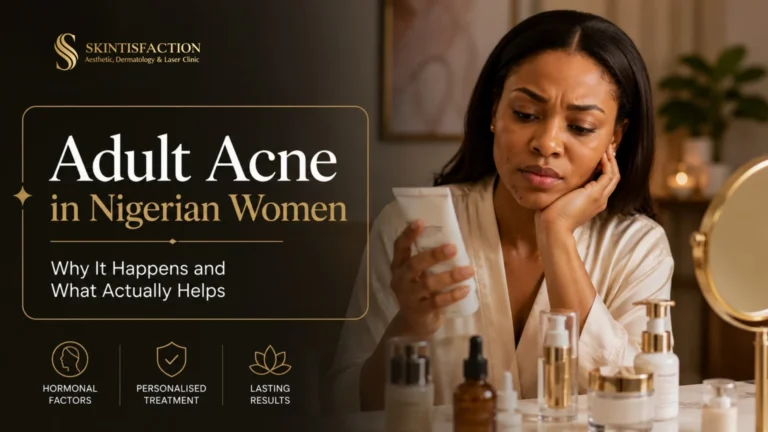
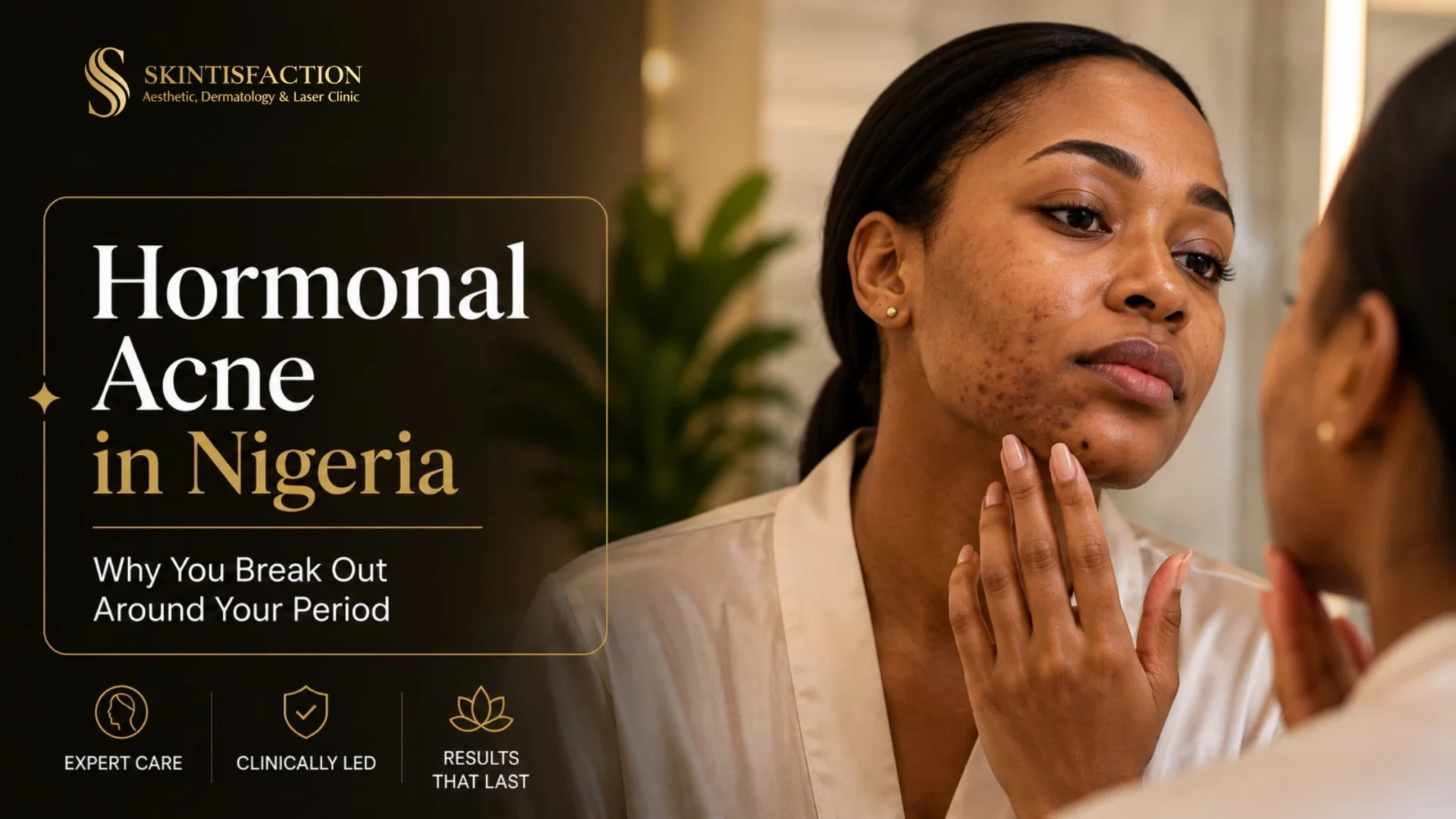
You do everything right for most of the month. Your skin is relatively clear, your routine is consistent, and things feel manageable. Then, like clockwork, the breakouts arrive. Same time, same location, same frustration.
If this pattern sounds familiar, you are not imagining it. Hormonal acne in Nigeria is one of the most common skin concerns Dr. Uzo sees at Skintisfaction, and it is also one of the most persistently mismanaged. Not because it is difficult to treat, but because most women spend years addressing the symptoms without ever getting to the root cause.
What Hormonal Acne Actually Is
Hormonal acne is acne that follows your menstrual cycle. It tends to arrive in the week before your period, peak around the time it begins, and then gradually clear, only to repeat the following month.
The location is usually distinctive: lower face, jawline, and chin. The breakouts themselves are often deeper and more painful than surface-level spots, sitting under the skin as cysts or nodules rather than coming to a visible head. They can feel tender before they are even visible, which is part of what makes them so recognisable once you know what you are dealing with.
In the second half of your cycle, oestrogen drops and other hormones rise, triggering your skin’s oil glands to produce more oil than usual. Pores congest, and the conditions for a breakout are set. Research published in PMC confirms this hormonal shift drives excess oil production and clogs the follicles.
This is not the same as teenage acne, which is driven primarily by the initial hormone surge at puberty. Hormonal acne in adult women is cyclical, predictable, and often begins or worsens in the 20s and 30s, long after adolescence. It also responds poorly to the products typically used for general acne, which is why so many women feel like they have tried everything and nothing works. That experience is not a failure of effort. It is a signal that the treatment and the cause are mismatched.
Signs Your Acne May Be Hormonal
Not all adult acne is hormonal. These are the markers that suggest it is:
- Breakouts reliably appear in the week before your period
- Acne clusters along the jawline, chin, or lower cheeks
- Spots are deep, painful, or cystic rather than surface-level
- Acne has continued or worsened into your 20s or 30s
- Breakouts consistently leave dark marks that take months to fade
If several of these apply, the pattern is worth discussing with a dermatologist rather than continuing to manage it with products alone.
Why Melanin-Rich Skin Has More at Stake
For most skin types, a hormonal breakout is temporary. It arrives, it clears, and the skin returns to baseline. For melanin-rich skin, the picture is more complicated.
Every breakout carries the risk of dark marks that remain long after the spot itself has healed. Darker skin is more reactive to inflammation, which means a single breakout can leave a mark that lingers for months, sometimes significantly longer.
According to NIH StatPearls, acne-related discolouration affects up to 65% of people with darker skin tones, and the darker the skin, the more intense and longer-lasting it tends to be. For women dealing with cyclical hormonal breakouts month after month, this is not one mark fading. It is a continuous cycle of new inflammation and new pigmentation, layering on top of marks that have not yet resolved.
The cumulative effect is significant. A woman who has been breaking out on a monthly cycle for two or three years may have built up considerable dark marking across the lower face, all of it originating from breakouts that were individually managed but never stopped at the source. If you are already dealing with lingering dark marks, our article on hyperpigmentation treatment in Lagos covers what actually works to address them. But the more important step is stopping the breakouts that create new ones. This is why hormonal acne on melanin-rich skin deserves clinical attention rather than a long-term skincare management strategy. A breakout that never starts does not leave a dark mark.
Conditions That Make It Worse in Nigerian Women
Hormonal acne does not always occur in isolation. Several conditions common in Nigerian women can amplify the hormonal signals driving it.
PMOS (polyendocrine metabolic ovarian syndrome), formerly known as PCOS, is the updated terminology introduced in 2026 following an international consensus published in The Lancet. It is a hormonal condition affecting a significant proportion of reproductive-age women and is widely underdiagnosed. One of its most visible symptoms is persistent acne, particularly along the jawline and lower face, alongside excess facial hair and dark patches on the skin. These skin changes are driven by an overproduction of certain hormones, which explains why acne associated with PMOS tends to be more severe and less responsive to standard treatment. If your acne is severe or accompanied by irregular periods, unexplained weight changes, or excess hair growth, PMOS may be a contributing factor worth investigating.
Chronic stress raises the body’s stress hormones, which can worsen inflammation, oil production, and hormonal imbalance. For professionals managing demanding workloads, long commutes, and the relentless pace of Lagos life, chronic low-grade stress is not abstract: it shows up on the skin. It also makes the skin less able to recover between cycles, meaning each month’s breakout lands on skin that has not fully resolved the last one.
Diet compounds the picture further. Foods that spike blood sugar quickly, common in the Lagos food environment, push the body to produce more oil and more inflammation. If you have read our article on how hormones affect your skin, you will already be familiar with how these patterns connect.
Any of these factors makes purely topical treatment less effective. Addressing the breakout on the surface while the underlying driver continues unchecked is the reason so many women cycle through products without lasting improvement.
Why Topical Products Alone Are Not Enough
This is the point that most skincare content avoids saying directly: if your acne is hormonal, no topical product will stop it from coming back.
Topical treatments work on the skin’s surface. They can reduce the severity of individual breakouts, manage bacteria, and help with the dark marks left behind. What they cannot do is interrupt the hormonal process that triggers the breakout in the first place. The cycle will repeat next month regardless of how well the skincare routine is maintained.
Over-the-counter acne products are formulated for the excess oil and bacterial activity that drive general acne. They are not designed to address the hormonal pattern behind cyclical breakouts. Many women spend years rotating cleansers, serums, and spot treatments in response to a problem that requires a different kind of intervention altogether. Some have tried prescription topicals from a pharmacy without a proper assessment, which may reduce visible breakouts temporarily, but still does not address what is driving them.
This is not a failure of discipline or consistency. It is a mismatch between the treatment and the cause, and recognising that distinction is the first step toward actually resolving it.
What Clinical Treatment Looks Like
A Clinical Dermatology consultation at Skintisfaction begins with a proper assessment of what is actually driving the pattern. Dr. Uzo will look at the full picture: the cycle and when breakouts occur, the distribution and type of acne, skin history, any relevant conditions such as PMOS, diet, stress levels, and any treatments already tried.
Treatment is built around the root cause, not just the visible breakout. Depending on what the assessment reveals, this may include prescription topical options that work more specifically on hormonal acne than over-the-counter products, oral medication where clinically appropriate, and in-clinic treatments to address active breakouts and the dark marks already present.
The goal is to interrupt the cycle, not manage individual episodes of it. For melanin-rich skin, where the long-term cost of repeated inflammation is high, that distinction matters considerably.
There is no single protocol that applies to every patient. The approach at Skintisfaction is specific to what is driving your skin’s pattern, which is what makes clinical treatment substantively different from managing it yourself.
If the Pattern Is Established, It Is Worth Addressing Properly
If you have been breaking out on a predictable schedule for months or years, that pattern is not going to resolve on its own. The skin does not correct hormonal acne over time the way it might clear up a stress-related breakout or a reaction to a new product. The cycle continues because the underlying hormonal trigger remains active.
A consultation is not a last resort. It is the logical next step once it is clear that what you are dealing with is hormonal, cyclical, and not responding to what you have already tried.
If your breakouts follow the same monthly pattern, it may be time to stop treating them as isolated flare-ups. Book a consultation with Dr. Uzo at Skintisfaction for a proper assessment and a treatment plan built around what is actually driving your skin. Book your appointment here.