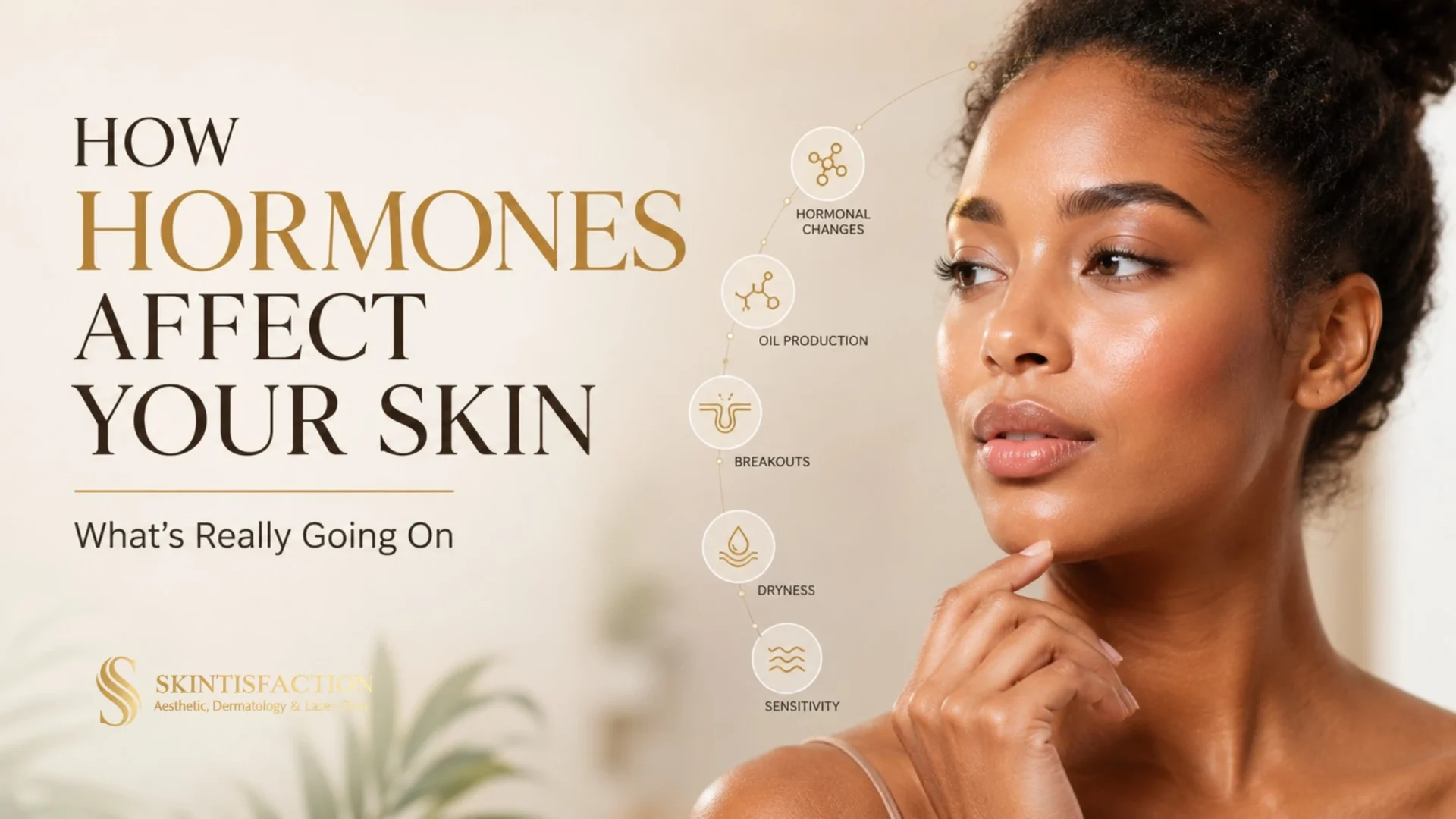
You’ve sorted your skincare routine. You’re drinking water, getting some sleep, using decent products. And yet your skin keeps doing things you can’t explain: breaking out on a schedule, going dull during your worst weeks at work, or shifting in texture for no obvious reason. If this sounds familiar, hormones are probably involved. And they’re doing a lot more to your skin than most people realise.
This article breaks down how hormones affect your skin, which ones matter most, and when those effects cross the line from normal fluctuation into something worth addressing with a dermatologist.
What Are Hormones and Why Does Your Skin Care About Them?
Hormones are chemical messengers produced by glands throughout the body (your ovaries, adrenal glands, pancreas, thyroid, and others). They travel through the bloodstream and deliver instructions to cells and organs, telling them what to do and when.
Your skin is one of the most hormonally sensitive organs in the body. Skin cells carry receptors that respond directly to hormonal signals, which is why hormonal shifts can affect your skin so visibly. Depending on which hormones are involved and whether they’re rising or falling, those shifts can change how much oil your skin produces, how fast it renews itself, how well it holds moisture, and how quickly it heals.
Grasping this is the first step to making sense of why your skin behaves the way it does.
How Hormones Affect Your Skin: The Key Players
Oestrogen
Oestrogen is one of the most skin-friendly hormones. It supports collagen production, helps the skin retain moisture, and maintains the outer barrier. When oestrogen levels are healthy and stable, skin tends to look plump, even, and well-hydrated.
The flip side: when oestrogen drops (during the days before your period, in the postpartum period, or during perimenopause), skin can feel noticeably drier, thinner, and less resilient. This is not a skincare problem. It’s a hormonal one.
Progesterone
Progesterone rises in the second half of the menstrual cycle (after ovulation). It increases sebum production and can make pores appear larger, and skin feel more congested. For many women, this is the window when breakouts appear (usually along the jawline, chin, or lower cheeks) even when nothing else in their routine has changed. This is why the timing of breakouts is often the clearest clue that hormones are driving them.
Androgens
Androgens (which include testosterone) are present in both men and women. When androgen activity is elevated, sebaceous glands produce more oil, which creates the conditions for acne. This is the mechanism behind hormonal acne in both sexes, and it’s particularly relevant in conditions like polycystic ovarian syndrome (PCOS), where androgen levels tend to be higher than normal.
It’s also worth noting that you can have normal-range hormones and still experience androgen-driven acne if your skin’s receptors are particularly sensitive to androgens. This is one reason hormonal acne can persist even when blood tests look unremarkable.
Cortisol
Cortisol is your body’s primary stress hormone, released by the adrenal glands in response to pressure. In short bursts, it’s useful. When it stays elevated, skin problems follow. For many people managing the demands of work, long commutes, heat, and the general pace of urban Nigerian life, that sustained state isn’t unusual.
High cortisol levels increase inflammation, disrupt the skin barrier, slow wound healing, and can trigger or worsen acne. It also interferes with sleep, which compounds the problem. Skin that regularly flares during high-pressure periods is often responding to exactly this.
Insulin
Less obvious but worth understanding. When blood sugar spikes (after a high-carbohydrate meal or sugary drink), the body releases insulin to manage it. Insulin, in turn, stimulates androgen production, which drives sebum production. The link between a high-glycaemic diet and acne runs through this insulin pathway, not directly through the food itself. It also explains why the same meal can affect two people’s skin very differently, depending on their individual insulin sensitivity.
When Hormonal Shifts Hit Hardest
Hormones fluctuate constantly, but certain life stages bring more dramatic shifts and skin changes that are more visible during those stages.
The menstrual cycle creates a predictable monthly pattern. Oestrogen peaks around ovulation and drops sharply in the days before menstruation. Progesterone rises after ovulation and falls alongside it. This double drop is why many women notice their skin looking less radiant and more breakout-prone in the week before their period.
Pregnancy brings a sustained surge in oestrogen and progesterone, which is why many women report their best skin during the second trimester. The postpartum period reverses this sharply, and the resulting hormonal withdrawal can cause breakouts, dryness, and hair shedding simultaneously.
Perimenopause and menopause bring a gradual and then steep decline in oestrogen. Collagen production slows, skin loses moisture more quickly, and some women experience acne for the first time in their adult lives, driven by the relative increase in androgens as oestrogen falls.
None of these are signs that something has gone wrong. They are predictable, biological transitions. But knowing what’s driving the changes makes it much easier to respond appropriately.
Is Your Skin Problem Hormonal? Signs to Watch For
Not every skin concern is hormonal, but there are patterns that point in that direction:
- Breakouts that follow a consistent monthly pattern, particularly in the week before your period
- Acne concentrated along the jawline, chin, and lower cheeks
- Skin that reliably worsens during high-stress periods
- Acne that doesn’t respond to standard topical treatments or good skincare habits
- Noticeable changes in oiliness or dryness that don’t correlate with products or weather
- Skin changes that appeared or worsened around a major hormonal event (pregnancy, stopping contraception, perimenopause)
These patterns are useful signals, but they don’t replace a proper clinical assessment. In practice, patients often come in assuming their skin is hormonal when the underlying cause turns out to be something else entirely: a contact reaction, a nutritional gap, or an undiagnosed skin condition. Getting that distinction right matters because it determines what treatment will actually work.
What You Can Actually Do About It
The honest answer is that skincare alone has real limits when hormones are the root cause. A well-chosen routine can support your skin and reduce some of the visible effects, but it cannot regulate the hormonal activity driving them. That requires a different approach.
Start with a clinical assessment. A dermatologist can determine whether hormones are the primary driver of your skin concerns, rule out other causes, and identify whether there’s an underlying condition (such as PCOS or a thyroid issue) that needs medical attention in addition to skin treatment. This step matters more than most people expect, because treating the wrong cause delays results and often makes things worse.
Understand what clinical treatment looks like. For hormonal acne, this may include prescription topical or oral treatments that target sebum regulation, inflammation, or bacterial control. Where breakouts have left post-inflammatory marks or textural changes, chemical peels can be an effective addition to the treatment plan. Skin that has become dry or barrier-compromised due to hormonal changes calls for a structured repair approach that’s different again. Where androgens are chronically elevated, as in PCOS, skin treatment typically runs in parallel with broader hormonal management. These are not one-size-fits-all solutions. The treatment path depends on what’s actually driving the problem.
Address lifestyle factors in parallel. Nigeria’s climate adds a layer that most generic skincare advice ignores. Sustained heat and humidity affect how oily skin behaves, and air conditioning (which most Lagos professionals spend significant time in) can worsen dryness that’s already been amplified by hormonal shifts. Regular professional treatments, like a HydraFacial, can help counter the dehydration that climate-controlled environments can exacerbate. Diet patterns common in this environment, including high-glycaemic meals and frequent alcohol consumption at social events, can also feed the insulin-androgen cycle that drives acne. If you’d like personalised guidance on how nutrition is affecting your skin, our clinical nutrition team can help you work through it as part of a broader treatment plan. These aren’t things to feel guilty about, but they’re worth understanding and managing alongside clinical treatment.
Don’t rely on self-diagnosis. Products marketed at “hormonal acne” vary enormously in evidence base, and many simply don’t work for the specific mechanism behind your breakouts. The safest and most efficient starting point is a consultation focused on your individual presentation.
Frequently Asked Questions
The Bottom Line
Hormones are not a vague explanation. They are a specific, well-documented mechanism that affects nearly every aspect of how your skin looks and behaves. Understanding which hormones are involved, and when, makes sense of changes that might otherwise seem random.
If there’s a pattern to your skin concerns and what you’ve been trying isn’t working, the answer is unlikely to be in a different product. At Skintisfaction Aesthetic, Dermatology & Laser Clinic, consultations are designed to identify the exact cause of your skin changes and map out treatment that addresses it properly.