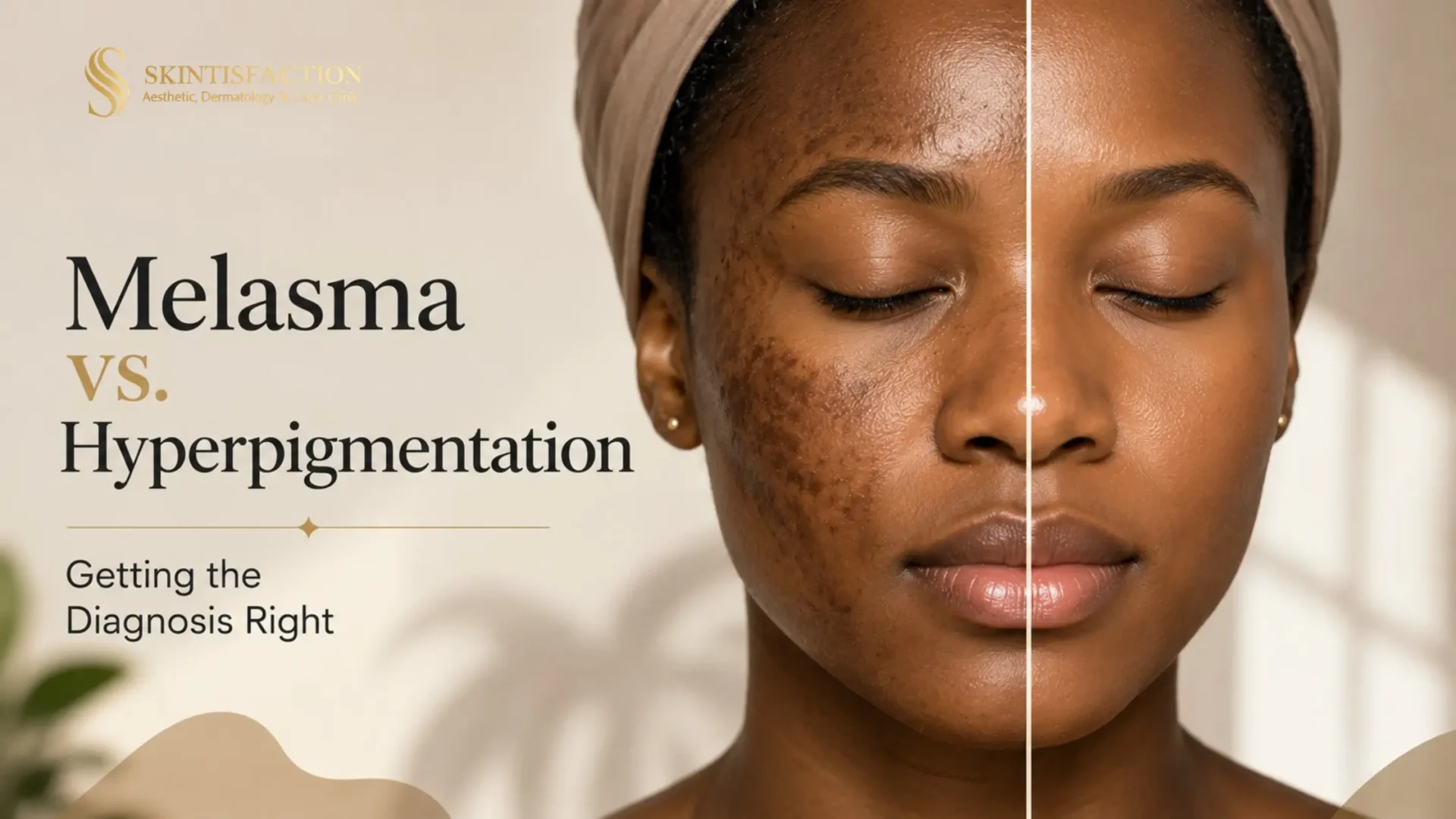
“Hyperpigmentation” gets used as a catch-all for almost any dark patch or mark on the skin. But medically, it’s a broad description, not a diagnosis.
That’s where the confusion with melasma comes from. Melasma vs hyperpigmentation gets treated as a straightforward comparison online, but the two aren’t equivalent things to weigh against each other. Melasma is a specific condition, one cause among several that fall under the broader hyperpigmentation umbrella, alongside things like post-inflammatory marks from acne or old injuries.
Telling someone they have “hyperpigmentation” is a bit like telling them they have “a headache.” True, but it doesn’t help you figure out what to do about it. This article sorts out where melasma fits in that bigger picture, and how to tell it apart from the rest.
Getting that distinction right matters more than it sounds. Treat the wrong one the wrong way, and you can end up with skin that’s more irritated or uneven than before.
What “Hyperpigmentation” Covers
Hyperpigmentation is a general term for areas of skin darker than the surrounding skin, usually because they have more melanin than normal. Dozens of different things can cause it.
One of the most common forms, particularly on darker skin, is post-inflammatory hyperpigmentation (PIH), the mark left behind after something irritates or injures the skin. According to the American Academy of Dermatology, this covers a wider range of everyday triggers than people usually expect:
- A healed pimple
- A cut, burn, or insect bite
- An irritating skincare product
- Certain medications
PIH shows up where that irritation happened, tracking the shape and location of whatever caused it.
If a medication is the suspected cause, that’s a conversation for whoever prescribed it, not a reason to stop taking it on your own.
What Melasma Is
Melasma is a specific pigmentary disorder, and it doesn’t work the same way. It is influenced by a combination of hormonal, genetic, and environmental factors, not one single cause.
The classic presentation is symmetrical, blotchy patches, usually across both cheeks, the forehead, the upper lip, or the bridge of the nose, without a specific injury behind it. Pregnancy and hormonal contraception are well-established triggers, but they’re not the whole picture. Genetics play a role, and so does light exposure.
That last point is worth pausing on. Most sun protection advice focuses on UV rays, but melasma also responds to visible light, the light you can see, not just the invisible wavelengths sunscreen typically blocks. This matters more for melanin-rich skin than it does for lighter skin. The American Academy of Dermatology specifically recommends a tinted sunscreen containing iron oxide for melasma, rather than relying on an untinted sunscreen alone.
Why the Two Get Confused
It’s an easy mix-up. Both show up as darker, uneven patches. Both are more common and more stubborn on melanin-rich skin. Both get worse with sun exposure, so “it’s worse when I’ve been in the sun” doesn’t help tell them apart. And most generic skincare advice lumps everything under one word: hyperpigmentation. That’s exactly where people go wrong.
How Melasma and PIH Differ
Here’s a side-by-side look at the patterns that usually separate them:
| Feature | Melasma | PIH |
|---|---|---|
| Typical pattern | Symmetrical patches | Marks following a specific injury or breakout |
| Common locations | Cheeks, forehead, upper lip, nose bridge | Wherever the irritation happened |
| Trigger | Hormonal, genetic, and environmental factors | Acne, cuts, burns, irritation, inflammation |
| Course | Persistent, tends to recur | Often fades gradually, though deeper marks can persist for months or longer |
| Can they coexist? | Yes | Yes |
A few takeaways from that table. Melasma tends to be symmetrical, showing up in roughly the same areas on both sides of the face. PIH follows the location of whatever caused it, so it doesn’t have to be symmetrical, though widespread acne or another inflammatory condition can leave marks across both sides of the face too.
Timing matters too. PIH often fades gradually once you control the underlying cause, but it can take months or longer, especially when the pigment sits deeper in the skin. Melasma is notoriously persistent and can return even after successful treatment.
Use these as things to notice, then let a dermatologist confirm the rest.
Can You Have Both?
Sometimes the answer isn’t one or the other. Someone with melasma can also develop PIH from acne, from irritation, or from a cosmetic procedure that didn’t suit their skin. When both are present at once, treating only one leaves the overall picture looking largely unchanged, which is often the frustrating situation that brings people in for an assessment in the first place.
Why the Diagnosis Changes the Treatment
Irritation can trigger or worsen pigmentation. That means a treatment that’s too aggressive for someone’s skin type, or mismatched to the specific kind of pigmentation they have, can leave skin darker or more uneven than when they started. A mismatched approach, not melasma treatment automatically backfiring, is usually what causes that setback.
Treating PIH as though it were melasma carries its own risk too, mainly that the underlying cause (often active acne) never gets addressed, so new marks keep forming even while old ones are being treated.
What Treatment Looks Like
The two conditions call for different priorities, not just different products.
For PIH, the order matters:
- Stop the inflammation first. If acne caused the PIH, treat the acne first, since new marks will keep forming as long as new breakouts do.
- Protect the skin from further pigmentation.
- Use topical treatments containing ingredients such as azelaic acid, vitamin C, or retinoids, which may help fade the remaining pigmentation once the trigger is under control.
- Add procedures only where needed for stubborn marks. Chemical peels can speed things up, but they’re one tool among several, not the automatic first step.
For melasma, the order is different:
- Photoprotection first, including visible-light protection (a tinted sunscreen containing iron oxide, not just standard SPF).
- Topical treatment. A dermatologist decides what’s appropriate for the individual, commonly prescription hydroquinone, tretinoin paired with a mild corticosteroid, or a prescription triple-combination cream.
- Carefully selected procedures where appropriate. On darker skin, the wrong peel strength or type raises the risk of new PIH forming on top of existing melasma, so selection and preparation matter more here than for most other concerns.
- Ongoing maintenance.
For melasma that remains difficult to control, a dermatologist may consider additional options such as tranexamic acid after reviewing your medical history.
There is no single best treatment for melasma, according to the American Academy of Dermatology. It is usually a combination, tailored to the individual, and results typically take several months to show, sometimes longer for melasma that’s been present for years.
When to See a Dermatologist
Book an assessment rather than continuing to guess if:
- Pigmentation isn’t fading with consistent home care after a reasonable period
- Patches are new, and you can’t explain what triggered them
- Pigmentation keeps returning despite treatment
- Pigmentation has gotten worse after a peel, facial, or other procedure, a sign the approach didn’t match what was there
Book a consultation to find out what is causing the pigmentation and which treatment approach is appropriate for your skin.
Getting the Diagnosis Right, Once
Both melasma and PIH are manageable. But “manageable” looks different for each, which is exactly why the diagnosis has to come before the treatment plan, not after.
Guessing based on generic advice, or treating melasma like a leftover pimple mark, wastes time at best and can make things worse at worst. A proper assessment tells you what you’re dealing with, so the plan you follow is built for your skin rather than borrowed from someone else’s.
If you’d like more background on hyperpigmentation broadly, our hyperpigmentation treatment guide covers the wider picture this article builds on.