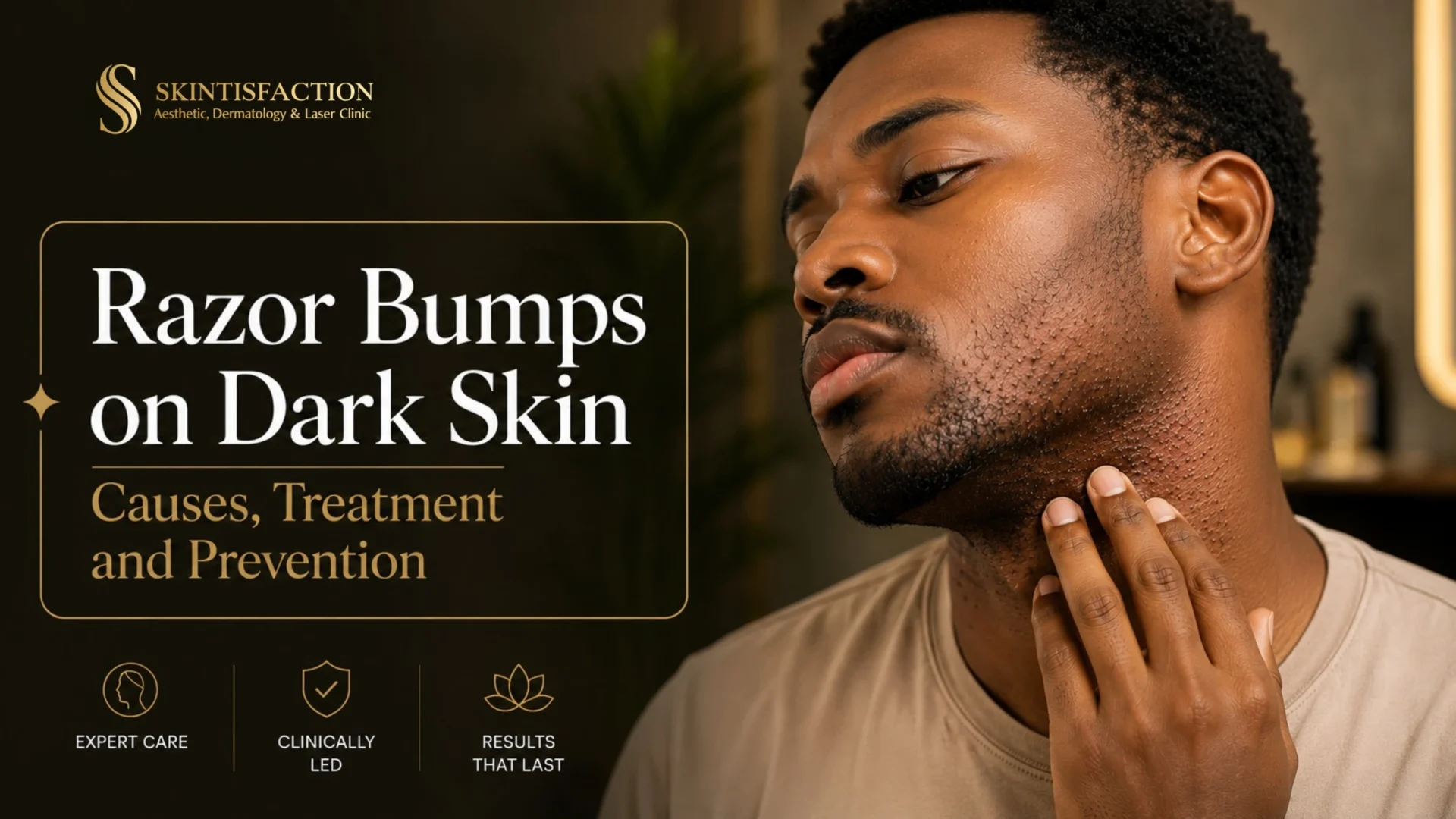
Careful shaving does not always stop the bumps. If you deal with small, tender bumps along your jaw or neck within a day of shaving, it is not because you are doing something wrong.
Razor bumps on dark skin are among the most common and misunderstood skin concerns we see at Skintisfaction. There is a clear reason they happen, and a clear path to fixing them.
What’s Actually Happening
The clinical name is pseudofolliculitis barbae, but you do not need the term to understand the mechanics.
If you have curly or tightly coiled hair, a shaved hair does not always grow straight out. The freshly cut hair curves back and re-enters the skin nearby, or it never fully exits the follicle. That trapped hair is what’s known as an ingrown hair, and the small, tender bump you see and feel is your skin’s inflamed reaction to it. Your body treats that regrowing hair as foreign and reacts with inflammation, which is what shows up along your jaw, chin, and neck.
This is not a hygiene issue. It is mechanical, rooted in hair shape. The tighter the curl pattern, the more likely a shaved hair is to curve back into the skin. That is why it affects some men constantly and others barely at all, regardless of how carefully either one shaves.
Anyone shaving curly or coarse hair on the neck, underarms, or groin can develop the same reaction, not just on the face. The neck and jawline tend to be the worst, since razor bumps after shaving there show up daily and rarely get the chance to fully heal.
Why It Hits Dark Skin Differently
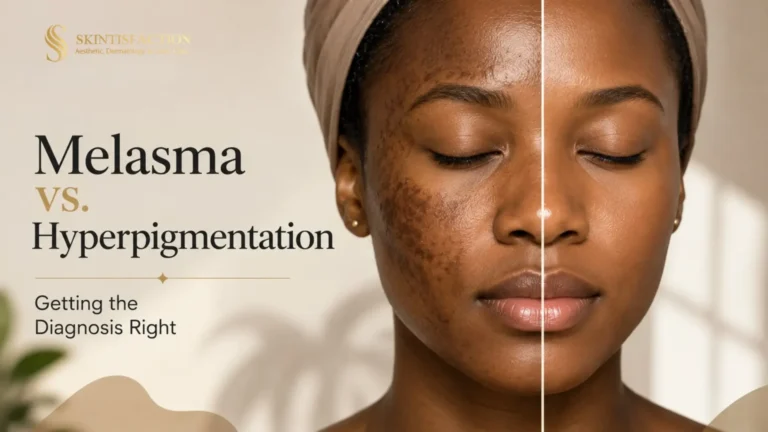
People with melanin-rich skin are more likely to experience razor bumps, but not because of melanin itself. Tightly curled hair, the actual driver of ingrown hairs, is simply more common in this population. What melanin does explain is what happens next: skin responds to that inflammation by producing extra pigment, and every bump that flares, gets picked at, or gets shaved over before healing has a real chance of leaving a dark mark behind. This is called post-inflammatory hyperpigmentation, and it is more common and more persistent in darker skin tones, particularly Fitzpatrick types IV to VI. It follows the same pattern seen with other hyperpigmentation triggers, not just shaving, and can take months to fade without treatment.
Repeated trauma from constant irritation or ingrown hairs that never resolve can also raise the risk of keloid-type scarring in people who are prone to it. Understanding melanin-rich skin is not an add-on for us. It is the foundation of how Dr. Uzo and the team approach conditions that show up differently, and more stubbornly, on darker skin.
What Makes It Worse
- Shaving too close, or against the grain. The closer the cut, the sharper the tip, and the easier it curves back in.
- Dull or multi-blade cartridge razors. These cut hair below the skin’s surface, increasing the chance of ingrown regrowth.
- Waxing and tweezing. Pulling hair from the root often makes ingrown hairs worse for curly hair types.
- Picking, squeezing, or digging at bumps. This raises the risk of a dark mark or scar. Never use tweezers, needles, or pins to dig out an ingrown hair. It usually makes things worse and can lead to infection.
- Skipping pre- or post-shave care. Shaving dry, unmoisturised skin leaves no protective barrier and no way to calm irritation afterwards.
Why Lagos Makes This Worse
Habits aren’t the whole picture. Where you live plays a part too.
Heat and humidity are not just uncomfortable. They actively work against your skin.
Sweat sits on freshly shaved skin for longer in Lagos humidity than it would somewhere drier, and that moisture combined with friction is exactly the environment bacteria and irritation thrive in. If you commute in traffic or spend your day in air conditioning that swings between cold and humid, your skin barrier is dealing with constant stress before it has even recovered from your morning shave.
Shirt collars and ties add another layer of friction, rubbing against a neck already irritated by shaving. This is a big part of why bumps show up first and heal slowest for professional men in Lagos.
This is not permanent or unbeatable. It means aftercare matters more here than it would in a cooler, drier place, and that a soothing, non-comedogenic aftershave is doing real work, not just finishing off a routine.
What You Can Do At Home
Good technique makes a real difference for most people, though it will not fix every case.
Know your hair’s direction. It often changes between your jaw, chin, and neck. Shave with the grain in each section rather than fighting it.
Use the right tool. A sharp single-blade or foil-style razor cuts cleaner than a multi-blade cartridge. If your job allows it, electric clippers with a guard, leaving roughly a millimetre of stubble, are often gentler than a fully close shave.
Shave warm, not dry. Shave at the end of a shower, or hold a warm compress on the area first. This softens the hair, making it less likely to curl back in as it regrows.
Aftercare matters. Rinse thoroughly, follow with a cool compress, and use an alcohol-free, soothing aftershave rather than anything drying.
A simple routine to follow:
- Wash with warm water to soften the skin.
- Apply shaving gel and let it sit for a minute or two.
- Shave with the grain, using a sharp single-blade razor or electric clippers.
- Rinse with cool water.
- Apply a fragrance-free moisturiser or soothing aftershave.
If your workplace allows it, shaving every other day instead of daily can also help. It gives your skin more time to recover between shaves and reduces how often already-irritated skin gets cut again.
If bumps are severe or constant, growing out your facial hair for a few weeks lets trapped hairs grow out naturally and lets inflamed skin properly settle. According to the American Academy of Dermatology, most men see noticeably fewer bumps within a month of stopping shaving, with continued improvement over about three months.
That said, home care has limits. Chronic bumps that return every time you shave, no matter how careful the technique, need more than a routine adjustment.
If that sounds familiar, a proper assessment can help identify what is actually going on, something we covered in more detail in our guide to men’s skincare in Lagos.
When To See a Dermatologist
Book a consultation rather than continuing to guess if:
- Bumps persist after several weeks of consistent, good technique
- You notice signs of infection: pain, pus, or spreading redness
- Dark marks have not faded weeks after the bump has healed
- Raised, thickened scarring starts to form
You do not have to live with it indefinitely. Book a consultation and let’s take a proper look at your skin.
What Treatment Looks Like
Treatment at Skintisfaction combines several approaches, depending on your skin’s needs.
For active, inflamed bumps, in-clinic extraction of stubborn ingrown hairs brings faster, safer relief than picking at home. Depending on severity, your dermatologist may also recommend a topical retinoid to keep hair from getting trapped as it regrows, a mild steroid cream to calm inflammation, a topical antibiotic if there are signs of infection, or a chemical exfoliant such as glycolic or salicylic acid to keep follicles clear. For marks that are already there, chemical peels can help speed up the fading of post-inflammatory hyperpigmentation.
For chronic, recurring bumps, the most effective long-term fix is not a better shaving routine. It is removing the need to shave that area at all. Laser hair removal targets the hair follicle directly, gradually reducing regrowth so there is less hair left to curl back in. Most people need a series of sessions, since hair grows in cycles and only active follicles respond at any given time. It addresses the actual cause rather than managing symptoms after each shave, and it is safe and effective on melanin-rich skin when performed by a team experienced in treating darker skin tones.
Good Skin, Without the Daily Battle
Razor bumps on dark skin are common, explainable, and treatable. You should not have to choose between a clean-shaven look and comfortable, even-toned skin. Whether that means refining your shaving routine, treating existing marks, or moving toward a permanent fix with laser hair removal, there is a path that actually fits your skin, not a generic one borrowed from someone else’s.
The earlier recurring razor bumps are treated, the easier it is to prevent long-term pigmentation and scarring.
Book your consultation and let’s find the right approach for you.