Tattoo removal for dark skin has come a long way. What was once considered risky for darker skin tones is now very achievable when done correctly. That last part matters more than most people realise.
If you have dark skin and you are considering tattoo removal in Lagos, the question you should be asking is not just “can this be done?” The more important question is “does this clinic understand how to do it safely for my skin?”
This guide walks you through exactly what makes tattoo removal for dark skin different, what risks exist when it is not handled properly, and what you should look for before choosing a clinic. If you are also wondering whether complete removal is realistic for your tattoo, we cover that in detail in our article on whether tattoos can be completely removed.
What Makes Tattoo Removal for Dark Skin Different
To understand why tattoo removal is more nuanced for darker skin tones, you need to understand what laser treatment is actually doing.
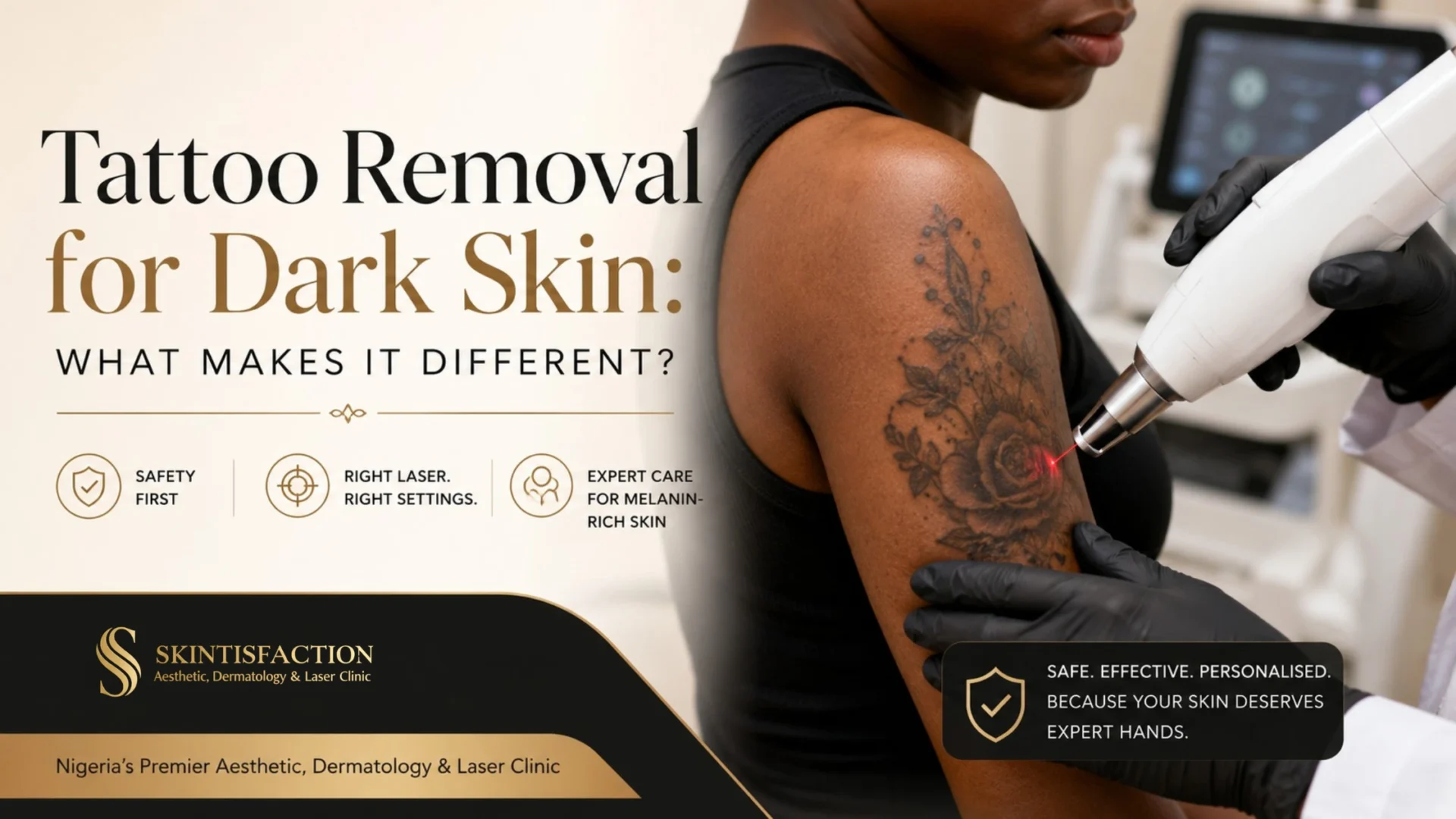
The laser targets pigment. It sends concentrated pulses of light energy into the skin, which are absorbed by the ink particles beneath the surface. Those ink particles heat up, break apart, and your body’s immune system gradually flushes them out over the following weeks.
The challenge with darker skin is that the laser cannot always distinguish perfectly between tattoo ink and the melanin in your skin. Melanin is the natural pigment that gives your skin its colour. The more melanin you have, the greater the risk that the laser energy intended for the ink ends up affecting the surrounding skin tissue instead.
Understanding how skin type affects treatment in Nigeria is a useful starting point if you are new to thinking about how your skin responds to procedures like this.
When that happens, the results can be more visible and more distressing than the original tattoo.
The Real Risks: Hyperpigmentation and Hypopigmentation
Two complications come up most often when tattoo removal goes wrong on dark skin.
Hyperpigmentation is when the treated area becomes darker than the surrounding skin. This happens when the laser triggers an inflammatory response, causing the skin to overproduce melanin as part of the healing process.
Hypopigmentation is the opposite. The treated skin becomes lighter, sometimes significantly so, creating patches that stand out against a darker complexion. This occurs when laser energy damages the melanocytes, which are the cells responsible for producing your skin’s colour.
Both conditions can be temporary or permanent, depending on the severity. Both are also largely preventable when the right laser is used at the right settings by someone who genuinely understands how darker skin responds to treatment. The American Academy of Dermatology notes that proper laser selection is especially important for patients with darker skin tones.
This is not a minor technical detail. It is the difference between a good outcome and a bad one.
Why Laser Type Makes All the Difference
Not all lasers are created equal, and not all of them are appropriate for dark skin.
Some lasers are designed with fair skin in mind. Used on darker complexions, they cannot reliably distinguish between tattoo ink and the skin’s natural pigment, which is exactly where complications begin. The laser energy meant for the ink ends up affecting the surrounding skin instead.
The lasers best suited for dark skin are those specifically designed to target ink particles while leaving the surrounding skin tissue alone. At Skintisfaction, our laser tattoo removal treatments use advanced technology selected and calibrated specifically for melanin-rich skin.
Before committing to any clinic, it is worth asking directly whether their equipment is appropriate for your skin tone. A clinic that cannot give you a clear answer to that question is one worth walking away from.
Why Practitioner Experience Is Critical
Having the right laser is only half the equation. How it is used is equally important.
For darker skin, a skilled practitioner needs to calibrate the treatment precisely for each patient. The energy level, the duration of each pulse, the spacing between sessions, and whether to do a test patch first all have to be considered based on your specific skin and tattoo.
A test patch on a small, discreet area of the tattoo is strongly recommended for darker skin tones. It allows the practitioner to assess how your skin responds before proceeding with the full treatment. Any reputable clinic should offer this as standard.
Treatment intervals also matter more for darker skin. Spacing sessions further apart, typically six to eight weeks minimum, gives your skin adequate time to heal between treatments and reduces the cumulative stress on the surrounding tissue.
This level of precision requires proper training and, just as importantly, real clinical experience treating patients with darker skin specifically.
In Lagos, this is where things get complicated. Tattoo removal is being offered in settings where the practitioners do not have the training or the equipment to handle melanin-rich skin safely. People are making decisions based on price or proximity, without asking the questions that actually protect them. Our guide on how to spot qualified aesthetic practitioners in Lagos covers the warning signs worth knowing before you commit to any clinic.
The consequences are real. Patients end up with pigmentation changes that are harder to treat than the tattoo they started with. Correcting those complications often requires additional treatment and significantly longer recovery timelines.
Choosing a medically supervised clinic with documented experience in laser treatments for dark skin is not a luxury. For your skin type, it is a necessity.
What Recovery Looks Like for Dark Skin
Recovery after laser tattoo removal on darker skin requires a bit more attention than it might for lighter complexions, particularly in the first few days after each session.
Immediately after treatment, you can expect some redness, mild swelling, and a frosted or whitish appearance on the treated area. This is completely normal and fades within a few hours. Over the following days, the area may blister, scab, or peel as part of the healing process. It is important not to pick at any scabbing, as this increases the risk of scarring and pigmentation changes.
Sun protection is non-negotiable. Lagos sun exposure can be intense, and UV exposure on a healing treatment site can trigger post-inflammatory hyperpigmentation. Keeping the area covered and applying a broad-spectrum SPF 50 sunscreen consistently is essential throughout your treatment course.
Moisturising the area as directed helps support the skin barrier during healing. Your clinic should provide specific aftercare instructions tailored to your skin type, not a generic aftercare sheet. If you experience any unexpected skin changes after treatment, our clinical dermatology team can assess and manage them early before they become harder to correct.
Who Is a Good Candidate?
Most people with unwanted tattoos on darker skin are suitable candidates for laser removal, though the expected outcome depends on a few factors.
Black, dark blue, and dark red inks are the most responsive to laser treatment and typically clear well. Brighter colours like green, light blue, and yellow are more stubborn and may require more sessions or result in significant fading rather than complete removal.
Older tattoos tend to respond more quickly because the ink has already begun to break down naturally over time. Larger tattoos, cover-up tattoos, or tattoos with heavy ink saturation will require more sessions.
A realistic expectation for most patients is significant fading across six to twelve sessions, with many tattoos clearing completely. The exact number of sessions depends on your specific tattoo and how your skin responds.
The best way to understand what is possible for your tattoo is a proper consultation before treatment begins. At Skintisfaction, we assess the tattoo, your skin type, and your goals before recommending a treatment plan. There are no one-size-fits-all answers here.
Frequently Asked Questions
Ready to Take the Next Step?
If you are considering tattoo removal, the most important decision you will make is where you go for treatment. For darker skin, that decision carries real consequences.
At Skintisfaction, our laser tattoo removal treatments are performed under full medical supervision using advanced laser technology calibrated specifically for melanin-rich skin. We assess every patient individually before treatment begins and provide a personalised plan based on your tattoo, your skin, and your goals.
Book your tattoo removal consultation today and start with a personalised consultation designed specifically for your skin type.