Most people who end up at a dermatologist’s door have already spent months, sometimes years, trying to sort their skin out on their own. They’ve built routines, switched products, followed advice online, and stayed consistent. And still, something isn’t right.
If that’s where you are, knowing when to see a dermatologist in Nigeria isn’t always obvious. The line between “give it more time” and “this needs professional attention” can be genuinely hard to read. In many cases, the difference between managing a concern and actually resolving it comes down to timing, and this article is here to help you figure out where you stand.
What Home Care Does Well
Home care is genuinely useful, and it’s worth saying that before anything else. A consistent routine with the right products can maintain healthy skin, manage mild concerns, support professional treatments, and even prevent certain issues from developing in the first place. For many people, this is enough.
But home care works at the surface level. Even the most well-formulated serums and creams can only penetrate so far. They’re designed to support skin health, not to diagnose conditions, treat active medical concerns, or reverse more serious damage. There’s a ceiling to what they can achieve, and that ceiling is lower than most people realise.
The problem is that in Nigeria, a lot of people are managing significant skin concerns entirely on their own. Partly because clinic visits feel like a big step, partly because of cost concerns, and partly because there’s so much skincare information available online that professional advice can feel optional. Often, it isn’t.
When to See a Dermatologist in Nigeria: Clear Signs It’s Time
These aren’t meant to alarm you. They’re meant to help you recognise your own situation clearly.
You’ve Been Consistent for Months, and Nothing Has Changed
If you’ve been using a product or following a routine for eight to twelve weeks without any meaningful improvement, that’s a signal worth paying attention to. Products that are going to work typically show some progress within that window. Continuing indefinitely without results isn’t patience. It’s guessing.
Your Dark Spots Keep Coming Back or Getting Darker
This is one of the most common concerns for people with melanin-rich skin in Nigeria, and it’s also one of the most misunderstood. Persistent or worsening hyperpigmentation, including conditions like melasma and post-inflammatory hyperpigmentation, often can’t be managed with brightening creams alone. They require clinical assessment to understand what’s actually driving the pigmentation, because the treatment depends entirely on the cause. Lagos’s year-round sun exposure and humidity can also trigger and worsen pigmentation in ways that make self-treatment particularly difficult, a factor a dermatologist will account for in your plan.
Your Acne Keeps Returning No Matter What You Try
There’s a difference between the occasional breakout and acne that comes back consistently, spreads, or leaves marks behind. Recurring or cystic acne usually has an internal component, whether hormonal, bacterial, or both, that topical home care can’t address on its own. A dermatologist can get to the root of it, whether that means prescription medication, a clinical treatment plan, or investigating an underlying trigger that over-the-counter products simply aren’t equipped to reach.
You’re Not Actually Sure What’s Wrong With Your Skin
This one is more common than people admit. Many people are treating a condition they haven’t properly identified, which could mean they’re using the wrong products entirely and potentially making things worse. A dermatologist gives you an accurate diagnosis before any treatment begins, and that changes the approach entirely.
Your Skin Reacted Badly to Something
In Lagos, especially, this is a real concern. The market is full of unregulated skin-lightening products and unqualified practitioners offering treatments that cause serious damage to melanin-rich skin. If your skin has been through something, whether a product, a treatment, or a procedure done elsewhere, that left it worse than before, you need a professional assessment, not another attempt at home remedies.
Your Skin Concern Is Affecting Your Confidence
This doesn’t get said enough: you don’t need to be dealing with something “severe” to deserve professional help. If a skin issue is on your mind every day, affecting how you show up at work or how you feel in social situations, that’s reason enough to see a dermatologist. There’s no severity threshold you need to meet first.
If you’re still unsure when to see a dermatologist in Nigeria, the patterns above are usually your answer.
Why Melanin-Rich Skin Needs Specialist Care
For people with darker skin tones, the stakes of getting skincare wrong are higher. Melanin-rich skin is more prone to post-inflammatory hyperpigmentation, which means that the wrong product, the wrong peel, or the wrong laser setting doesn’t just fail to help. It can cause significant, lasting damage that takes months or years to address.
This is why the experience of your provider matters so much. A dermatologist with genuine expertise in melanin-rich skin doesn’t just treat your current concern. They approach every decision knowing how your skin is likely to respond, and that knowledge is protective in ways that no home care routine can replicate.
At Skintisfaction, Dr. Uzo works specifically with melanin-rich skin every day. The protocols here are built around the particular needs and risks associated with darker skin tones, drawing on international standards of care adapted to the Nigerian context. That means every treatment decision, from the choice of peel to the settings on a laser, is guided by expertise in how melanin-rich skin behaves, which is a very different approach to what you’d find at a generalist clinic or an unqualified provider.
What Happens at a Consultation
A lot of people put off booking a consultation because they’re not sure what to expect, or they worry they’ll walk in and immediately be sold an expensive treatment plan.
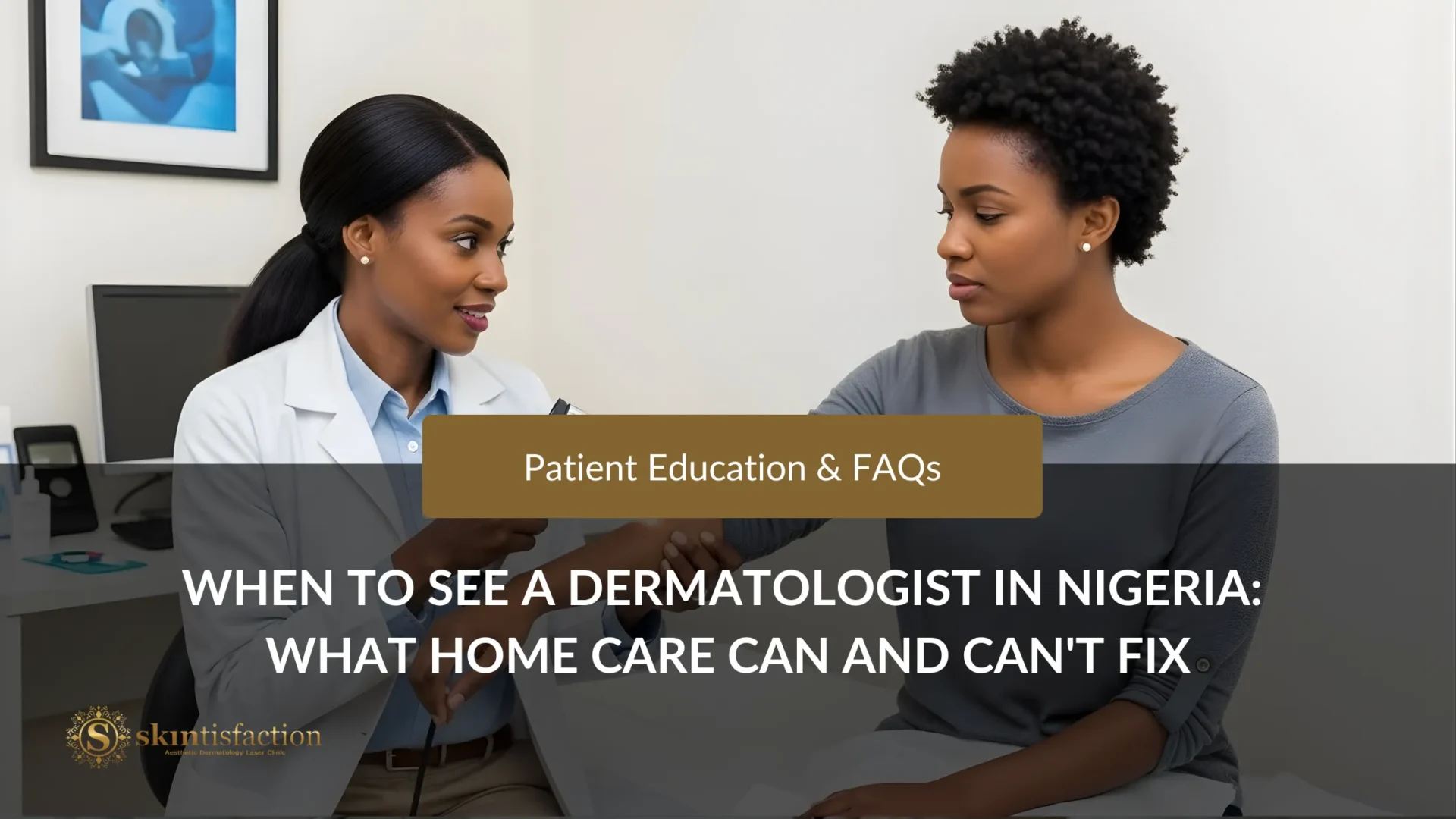
In reality, a dermatology consultation is primarily about assessment and information. Dr. Uzo will take a proper look at your skin, ask about your history, your current routine, and what you’ve already tried. From there, you’ll get an actual diagnosis and a clear picture of what’s going on and why. Skintisfaction consultations combine clinical assessment with advanced diagnostic tools, so your treatment plan is built on precision rather than guesswork, and tailored to your specific skin rather than a one-size-fits-all protocol.
It’s also worth reframing how you think about the cost. A single consultation that gives you a clear diagnosis could save you months or years of spending on products that aren’t working for your actual condition. In the long run, professional guidance is often more cost-effective than an indefinite trial-and-error approach.
Frequently Asked Questions
Your Skin Has Been Patient Enough
Home care has its place, and it does real things for your skin. But it has limits, and recognising those limits is not a failure. It’s just good sense.
Clear skin isn’t about trying harder. It’s about getting the right diagnosis.
If your skin isn’t responding to what you’re doing at home, the next step is straightforward. Book a consultation with Dr. Uzo at Skintisfaction and find out exactly what your skin needs to actually improve.
Book Your Consultation or call us to talk through your concerns before you commit to anything.
Skintisfaction Aesthetic, Dermatology & Laser Clinic | Lekki, Lagos. Specialist care for melanin-rich skin.